
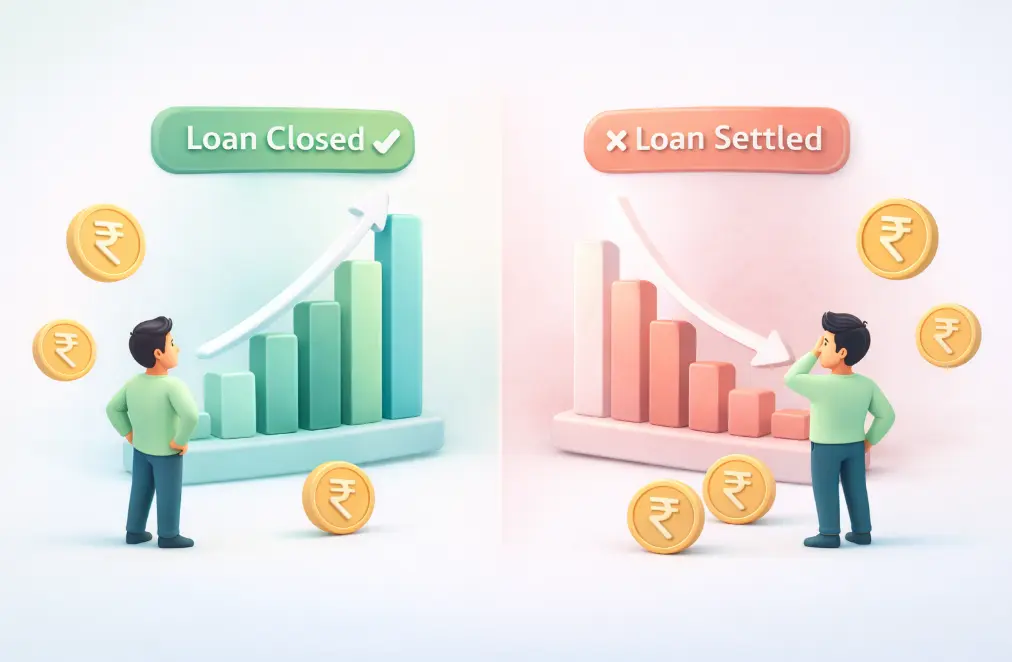
Understanding the difference between loan settlement and closure is essential for anyone managing a loan. While both processes end your loan account, they have completely different financial consequences. Loan closure reflects responsible repayment and improves your credit history, while loan settlement indicates that the borrower could not repay the full amount. Knowing the loan settlement vs closure meaning can help you make better financial decisions and protect your credit score.
What is Loan Closure?
Loan closure occurs when a borrower repays the entire loan amount according to the agreed terms. This may happen after completing all EMIs or by paying the outstanding amount before the tenure ends.
In simple terms, loan closure means the borrower has successfully cleared the debt and fulfilled the loan agreement.
This responsible repayment behaviour strengthens the borrower's financial credibility and helps maintain a positive credit history.
Types of Loan Closure
There are two common types of loan closure:
Regular Loan Closure
This occurs when the borrower completes the full repayment schedule by paying all EMIs until the end of the loan tenure.
Pre-Closure (Foreclosure)
Pre-closure happens when the borrower pays the remaining outstanding amount before the loan tenure ends.
Documents Received After Loan Closure
Once your loan is closed successfully, lenders typically provide several important documents.
| Document | Purpose |
|---|---|
| No Dues Certificate (NDC) | Confirms that the borrower has no outstanding loan balance |
| Loan Closure Letter | Official proof that the loan has been fully repaid |
| Collateral Release | Applicable for secured loans such as home or car loans |
| Credit Bureau Update | The loan status is marked as "Closed" in credit reports like CIBIL |
Keeping these documents safe is important because they serve as proof of loan repayment.
Benefits of Loan Closure
Choosing proper loan closure offers several long-term financial advantages.
Improves Credit Score
One of the major benefits of loan closure is that it reflects responsible repayment behavior.
Better Loan Eligibility in Future
Lenders prefer borrowers with a history of successfully closed loans.
Stronger Financial Reputation
A clean credit report shows that the borrower manages credit responsibly.
Avoids Default or Negative Credit Marking
Proper closure prevents your loan account from being marked as overdue or problematic.
Overall, loan closure is a positive outcome that supports long-term financial stability.
What is Loan Settlement?
Loan settlement occurs when a borrower is unable to repay the entire outstanding loan amount and negotiates with the lender to pay a smaller amount as a one-time settlement.
After accepting this payment, the lender closes the loan account but marks it as "Settled" instead of "Closed.
Understanding the loan settlement vs closure meaning is important because settlement indicates that the borrower did not repay the full loan.
Example of Loan Settlement
Consider the following example:
If a borrower owes ₹3,00,000 but due to financial hardship can only repay ₹1,50,000, the lender may accept this reduced amount as a final settlement.
The remaining unpaid amount is written off by the lender, and the loan account is marked as "Settled" in the credit report.
Loan Settlement Impact on Credit Score
One of the biggest concerns with settlement is the loan settlement impact on credit score.
Here are some potential consequences:
Immediate Credit Score Drop
The loan settlement affects CIBIL score and may reduce it by 75–150 points.
Difficulty in Getting Future Loans
Lenders may hesitate to approve new loans when they see a "Settled" status.
Higher Interest Rates
Even if the loan is approved, lenders may offer higher interest rates due to increased risk.
Negative Credit History
The "Settled" remark may remain on your credit report for up to seven years.
This is why settlement should only be considered in extreme financial situations.
When Should You Consider Loan Settlement?
Loan settlement should be treated as a last option rather than a regular repayment strategy.
You may consider settlement if:
You are facing severe financial hardship such as job loss.
Medical emergencies have affected your repayment ability.
Loan restructuring or tenure extension has already been attempted.
Repaying the full loan amount has become impossible.
Before choosing settlement, borrowers should try other alternatives such as restructuring the loan or adjusting repayment schedules.
How to Close Your Loan Properly?
If you want to maintain a strong credit record, it is important to follow the proper loan closure process. Steps for Proper Loan Closure:
Pay all remaining EMIs or the outstanding loan balance.
Request a No Dues Certificate (NOC) from the lender.
Collect the Loan Closure Letter as official proof.
Verify that your credit report shows the loan status as "Closed."
Cancel any auto-debit instructions linked to the loan account.
Following these steps ensures that your loan is closed correctly and your credit history remains clean.
Loan Closure vs Loan Settlement Comparison
Understanding the loan closure vs loan settlement comparison helps borrowers make informed decisions.
| Factor | Loan Closure | Loan Settlement |
|---|---|---|
| Repayment | Full repayment of loan | Partial repayment |
| Credit Report Status | Closed | Settled |
| Impact on Credit Score | Positive | Negative |
| Future Loan Approval | Easier approval | More difficult |
| Financial Reputation | Strong credit history | Risky credit profile |
This comparison clearly highlights the difference between loan settlement and closure.
Which One Should You Choose?
If you have the financial capacity to repay your loan, loan closure is always the better option.
Loan Closure offers:
Responsible financial behavior
Improved credit score
Better eligibility for future loans
Loan Settlement may provide temporary relief but comes with long-term credit consequences.
How Capital Now Helps You?
At Capital Now, the goal is to help borrowers make informed financial decisions.
The platform offers:
Clear understanding of repayment options.
Easy comparison of loan offers.
Quick online personal loan application.
Simple EMI management through a user-friendly dashboard.
With Capital Now, borrowers can manage loans responsibly and maintain a healthy credit profile.
Need a Personal Loan?
If you are planning a new loan or looking for better financial options, Capital Now provides a simple and secure digital borrowing experience.
Eligible users can apply for instant personal loans up to ₹1,50,000 through a fast and paperless process.
Conclusion
Understanding the loan settlement vs loan closure difference is essential for protecting your credit health. Loan closure reflects responsible financial behavior and strengthens your credit score, while loan settlement indicates that the borrower could not repay the full amount.
Before deciding between settlement and closure, borrowers should carefully evaluate their financial situation and long-term goals. In most cases, choosing proper loan closure is the best way to maintain a strong credit profile and ensure easier access to future loans.
Frequently Asked Questions
Ready to Take Control of Your Finances?
Download the Capital Now app today and start your journey towards smarter financial decisions. With personalized loan recommendations, expert tips, and real-time credit score monitoring, managing your finances has never been easier.